
What I Learned About Decanting Holbein Luminous Watercolor
Nana SunA long-term, real-world look at rewetting, cracking, color strength, and when tubes are the better travel choice
BY WANDERER'S PALETTE
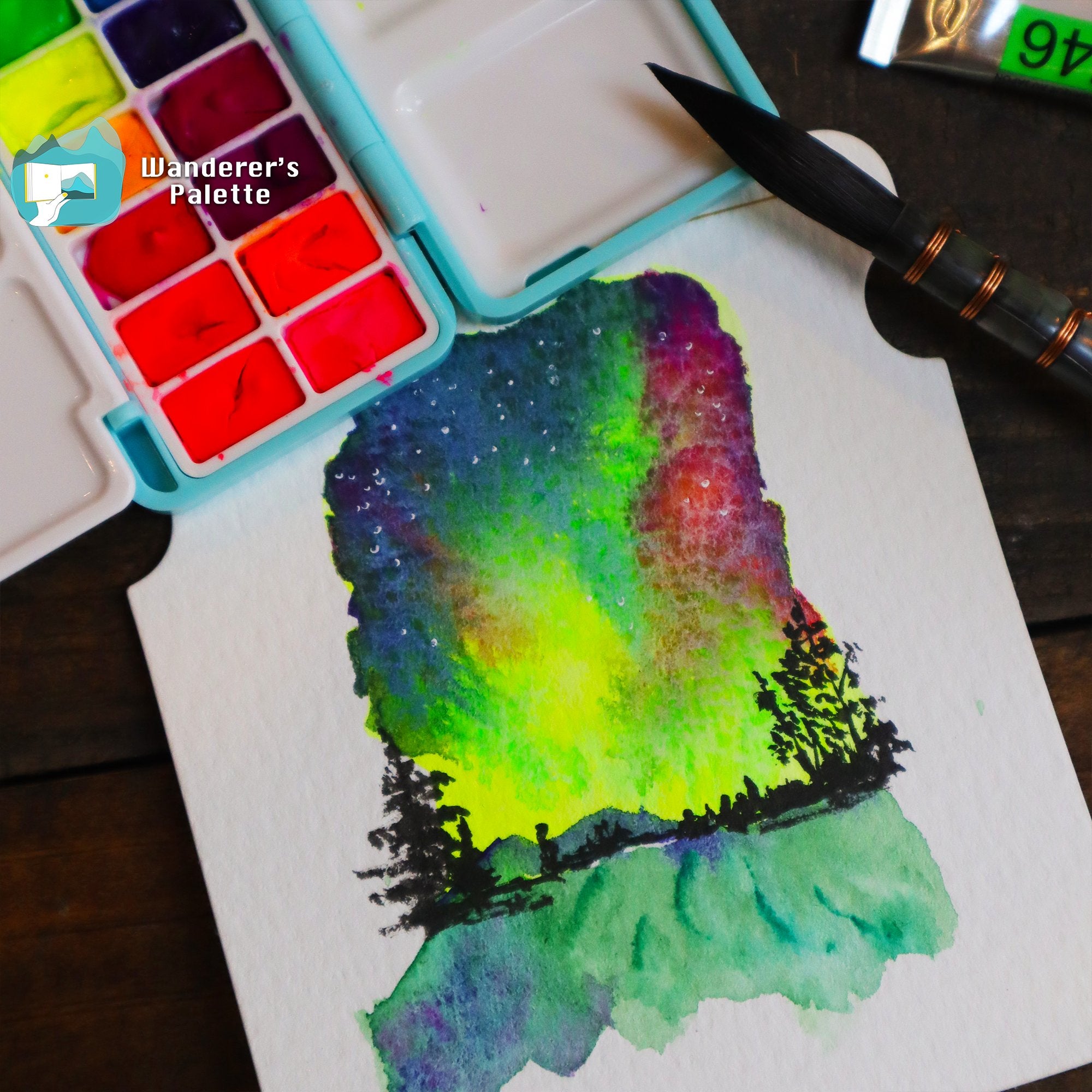
Fluorescent color is irreplaceable for auroras and quick studies; the question is not its beauty, but how well a decanted pan holds up over time.
Scope note: My first-hand findings in this article are about Holbein Artists' Watercolor Luminous Colors only. I am not saying that all Holbein watercolors—or every fluorescent watercolor brand—behave this way.
The short answer: possible, but not dependable for long-term storage
Can you squeeze Holbein Luminous watercolor from a tube into a travel pan? Technically, yes. Would I build a palette, put it away for months, and expect every color to perform like fresh tube paint? Based on my experience, no.
When the paints were newly poured, they looked beautiful. The intense color made a tiny travel palette feel exciting and useful. The trouble showed up later. As the pans aged, some colors became brittle or chalky, resisted rewetting, and released noticeably less color than paint used directly from the tube. One cake also loosened from its pan during shipping.
That experience changed my practice. For dependable color strength, I now prefer keeping Holbein Luminous colors in their tubes. If I decant them at all, I pour only a small amount that I expect to use relatively soon.
The problem appeared over time—not during the fresh-paint test
I briefly offered a small run of hand-poured palettes made with Holbein Luminous watercolor. The early palettes looked and performed well when they were fresh. The problem did not show up right away; it appeared only after the paint had dried and aged.
A customer later told me that several colors were unusually difficult to activate. Luminous Yellow—the yellow that leans orange in the set—released almost no usable color even after a long soak. Blue Violet felt chalky and slow to activate. A piece of Luminous Green had also broken loose during shipping.
I went back to one of my own earliest palettes from the same period and tested it again. I saw the same pattern: the aged pans no longer behaved like the fresh paint I remembered. That confirmed it for me. I issued a full refund, offered the remaining paint from the original tubes, and discontinued the hand-poured Luminous palette.
The customer was gracious about the response and said she would shop with me again. What mattered most was the lesson it reinforced for my product development: a palette must still work after the excitement of the first swatch has passed.
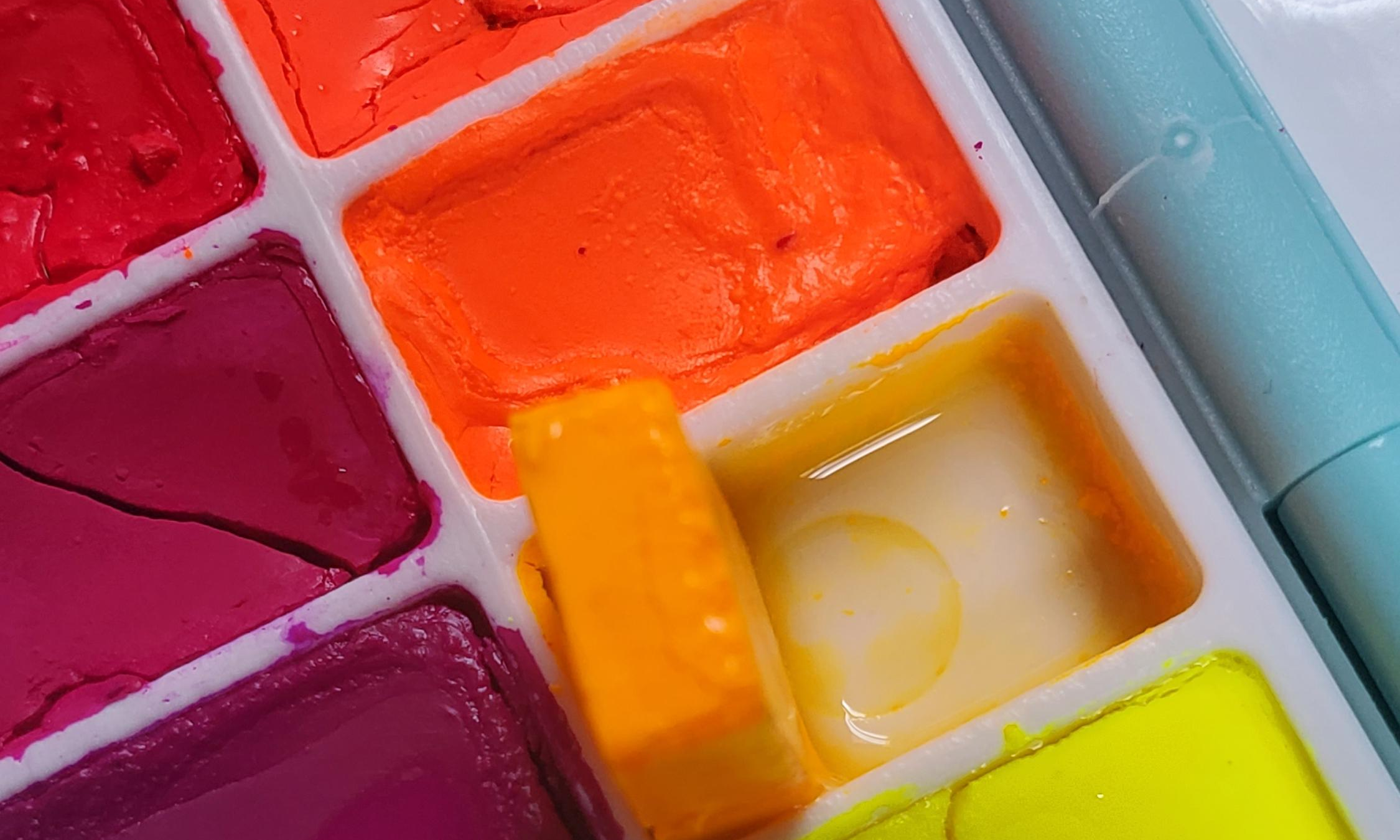
Aged Holbein Luminous pans showing surface cracks and a cake that has pulled away from the pan.
Drying changed both the texture and the color release
The most useful comparison was simple: the same Holbein Luminous paint in two states—straight from the tube and rewetted from an aged, hand-poured pan.
The tube paint released strong, luminous color quickly. The dried palette color needed much more work and still produced a weaker result. That difference matters outdoors, where a travel setup should save time rather than require extended soaking and scrubbing.
The physical changes were also visible. Some cakes shrank, cracked, or separated from the pan. Cracking alone is not proof that watercolor is ruined; many perfectly usable paints crack as they dry. In this test, however, the cracking appeared together with poor reactivation and reduced color strength. That combination made the palette unreliable.
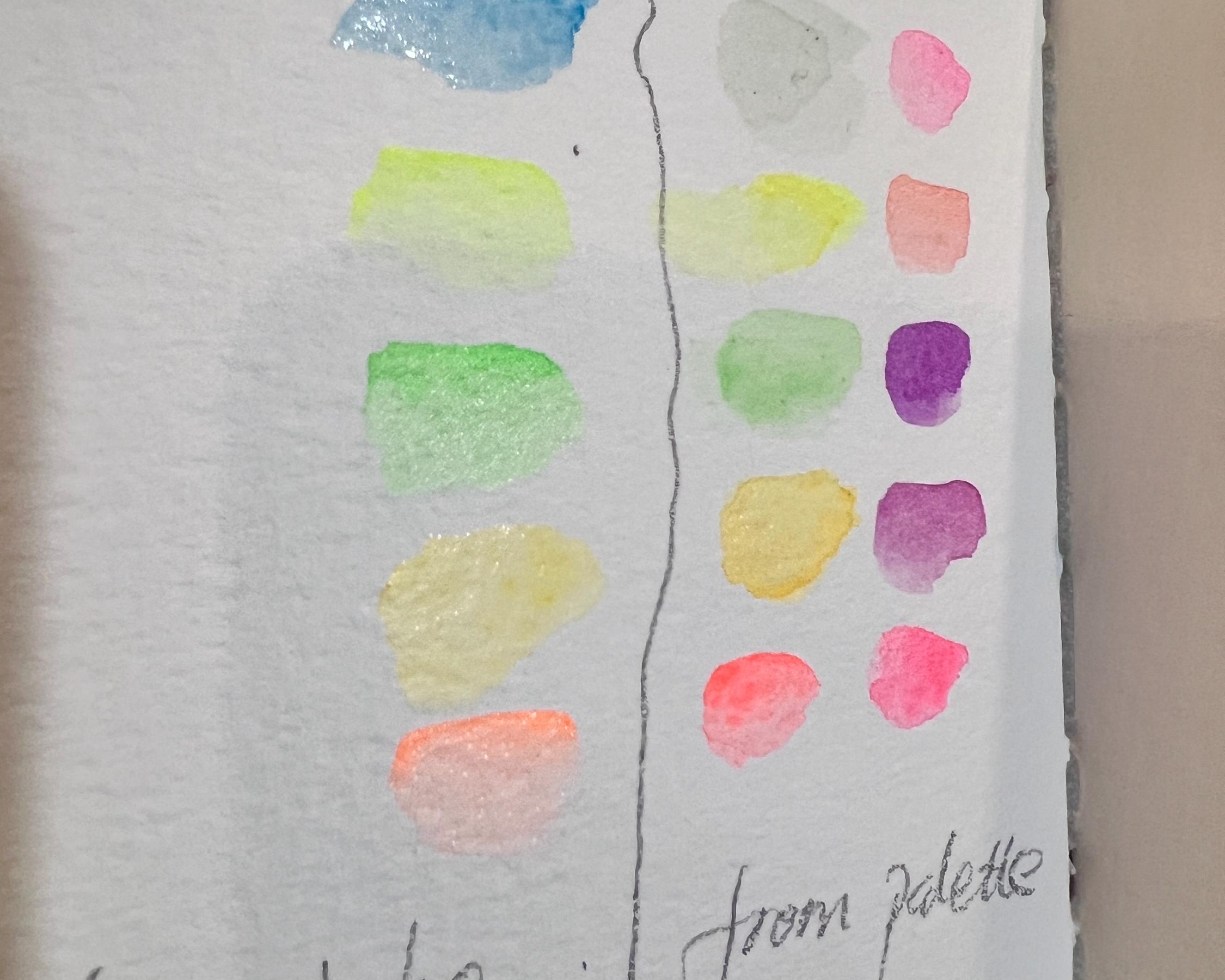
The same colors compared from fresh tubes and from the aged palette; the dried-palette swatches are weaker.
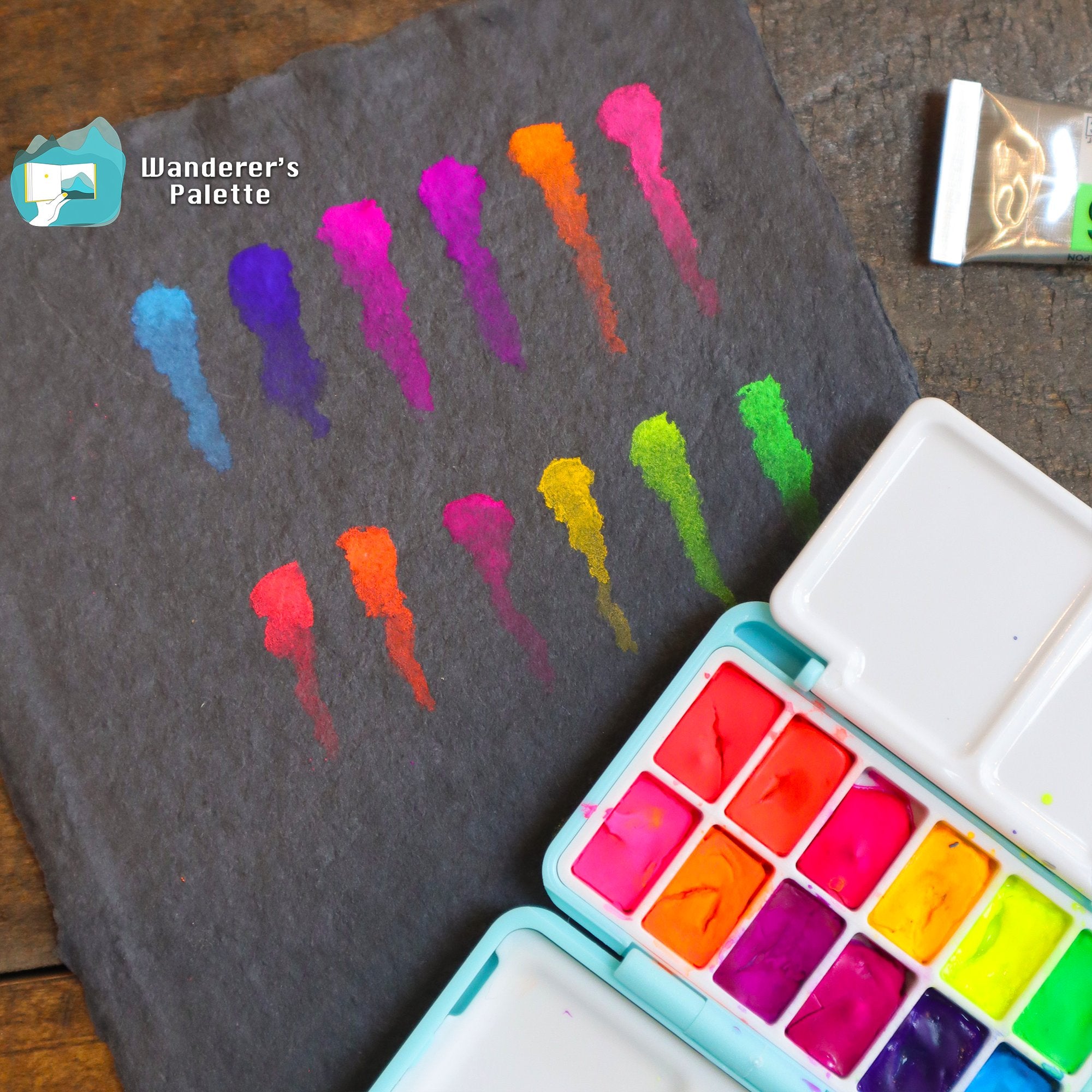
Fresh fluorescent color can be extraordinarily vivid, but notice the cracks in the pans: brilliance and long-term durability are different questions.
Fluorescence and rewetting are two different questions
Holbein describes the Luminous range as 12 fluorescent colors with high brightness and saturation. That explains what the line is designed to do; it does not promise that tube paint will make a durable, easy-rewetting pan. [1]
Fluorescent colorants are also a special category. Conservation research describes daylight-fluorescent artist colors as generally light-sensitive: exposure can reduce intensity or shift hue.[2] This is a reason to be cautious about displaying fluorescent originals in strong light, but it does not prove why a particular watercolor cake becomes hard to reactivate.
Rewetting depends on the full paint formulation—the pigment or dye, binder, humectants, wetting agents, pigment load, pour depth, drying conditions, and age. A retailer's note for Holbein Luminous says these colors resist rewetting and also notes that Holbein does not use ox gall. [3] That is consistent with my experience, but my conclusion still remains product-specific: the problem I observed was in aged, hand-poured Holbein Luminous pans.
So I test lightfastness and rewetting separately:
Rewetting test: Does the dried pan release strong color after a short pre-soak?
Aging test: Does it still reactivate after several weeks or months?
Light test: Does a painted swatch change when exposed to light compared with a protected control?
Travel test: Does the cake stay seated after normal carrying or shipping?
Other artists' reports show why brand-by-brand testing matters
My results with these Holbein pans should not be treated as a rule for every brand of fluorescent watercolor pans. Two third-party reports make that clear.
Third-party experience 1: Schmincke rewet well, but fluorescent additives faded early
Artist and independent paint tester Kimberly Crick reported that Schmincke Horadam colors generally rewetted easily from self-poured dry pans. In the same long-term review, however, she found that the fluorescent additives in all four colors labeled "Brilliant" showed signs of fading within the first few weeks of her lightfastness test. Some stable underlying pigments remained, so the final amount of change differed by color.[4]
That is a useful distinction: a paint can rewet well and still be light-sensitive. Easy activation is not evidence of archival permanence.
Third-party experience 2: tube-to-pan behavior varies even before neon enters the picture
In a WetCanvas discussion, one artist reported that dried M. Graham watercolor reconstituted extremely easily and stayed as vibrant as fresh paint. The same thread reproduced correspondence attributed to a Winsor & Newton technical representative advising that its tube and pan formulations differ, and that dried tube color may become crumbly and rewet with less clarity and brilliance. [5]
These are general tube-to-pan reports, not neon-specific tests, and forum reports are not controlled studies. I included them because they show why "watercolor always rewets" and "tube paint never belongs in pans" are both too broad. The exact brand, line, color, and storage history matter.
Practical conclusion: Treat every neon or fluorescent line as its own material. A good result from Schmincke, M. Graham, Daniel Smith, Winsor & Newton, Kuretake, or another brand does not predict Holbein Luminous—and my Holbein result does not predict theirs.
My safer workflow for a travel palette
If you want neon accents outdoors, you do not have to abandon them. Just build the setup around what the paint actually does.
Keep the main supply in the tube. A tube protects the original consistency and gives you a fresh benchmark whenever a pan starts behaving strangely.
Pour a test pan, not a full set. Start with one color and a small quantity. Label it with the brand, exact color name, and pour date.
Use thin layers. Allow each layer to dry before adding the next. Thin, staged pours can reduce shrinkage stress, although they cannot correct a formula that simply rewets poorly. [6]
Retest on a schedule. Swatch the pan when fresh, after one week, and then monthly. Use the same paper, brush, soak time, and approximate paint-to-water ratio.
Pre-wet before painting. Add a few clean drops of water and wait. For my aged Holbein Luminous colors, a long soak still did not fully restore the weakest pans, so soaking is a troubleshooting step—not a cure.
Store cool, dry, and dark. Let the palette dry completely before closing it, and keep finished fluorescent artwork away from strong daylight when longevity matters.
Use neon strategically. Fluorescent color is excellent for sketchbooks, scans, prints, studies, and accents where maximum archival stability is not the main goal.
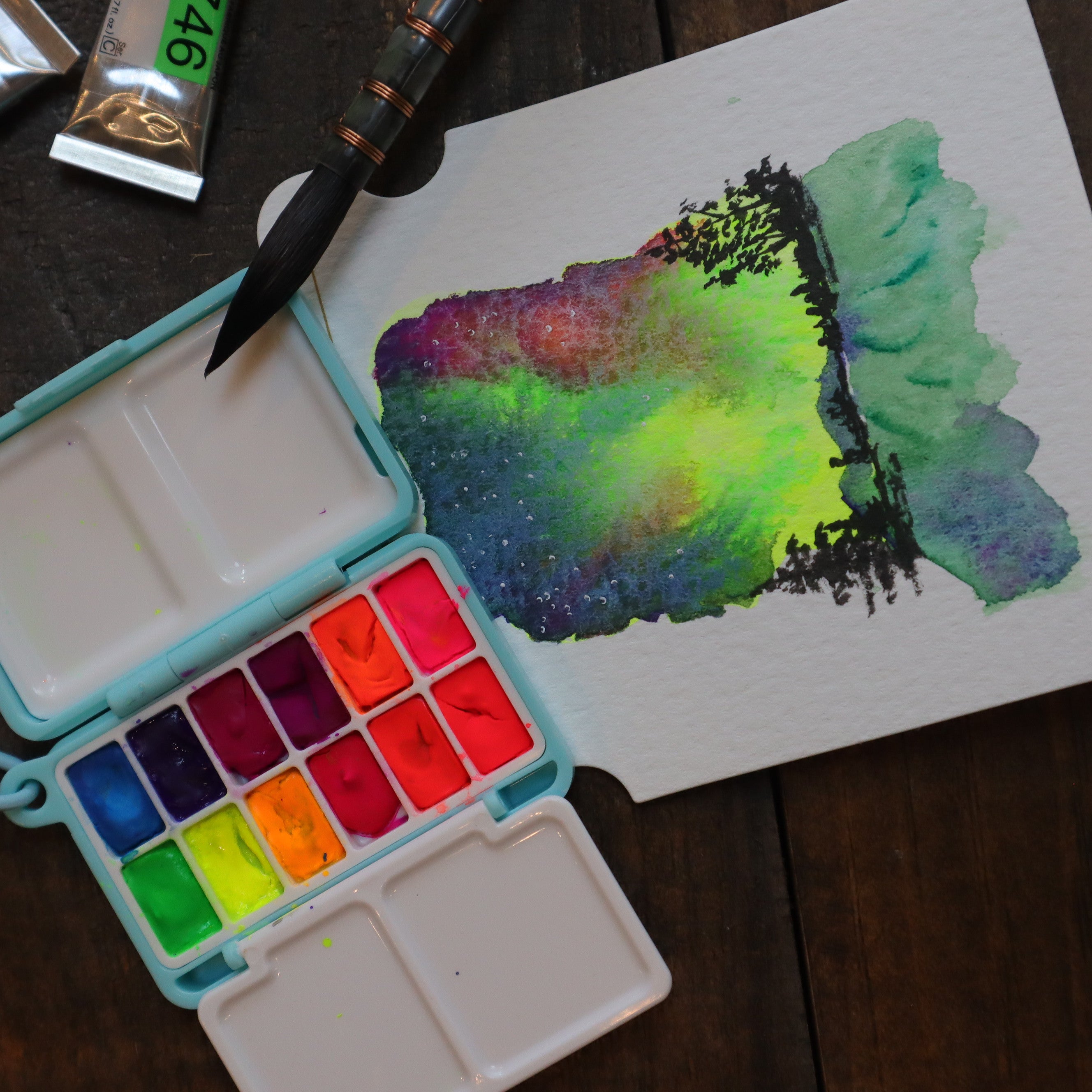
Give fluorescent color the right job: sketchbooks, auroras, and night-sky studies—not a long-stored workhorse travel pan.
Additives are not a universal fix
Artists often ask whether they should mix in glycerin, gum arabic, honey, or a commercial watercolor medium before filling pans.
My answer is: not automatically. Adding a material changes the manufacturer's formula. It may improve one problem and create another—tackiness, slower drying, different flow, more cracking, or altered color pickup. Kremer Pigmente notes that excess gum arabic can make a paint brittle and cracked, while humectants such as glycerol can improve flexibility and redissolving in handmade watercolor; Kremer also recommends thin, fully dried layers. [6] That is useful formulation guidance, not a guaranteed repair recipe for a finished commercial tube paint.
For Holbein Luminous, I would first test the paint unmodified. If it still fails your rewetting standard after aging, keep it in the tube rather than trying to reformulate it by guesswork. If you do experiment, use a separate sample pan, record the amount added, and never alter the whole tube.
Troubleshooting: diagnose the failure before trying to fix it
The pan cracked but still releases strong color
Keep using it. Surface cracks can be cosmetic. Pre-wet gently and avoid digging into the cake with a delicate brush.
The whole cake has fallen out
Place the cake back in the pan and wet only the contact surface to see whether it reseats as it dries. If it repeatedly comes loose, carry that color separately or refill with a small fresh layer. Do not assume that pressing harder will restore a brittle cake.
The color stays weak after pre-soaking
Compare it with fresh paint from the tube on the same paper. If the tube swatch is clearly stronger, the pan is no longer giving you the performance you bought the color for. Replace the pan with a small fresh pour or use the tube directly.
The paint feels chalky or powders under the brush
Stop scrubbing. Aggressive brushing can damage the brush and break the cake further. Test a small fresh pour. If the problem returns after drying, treat that color as tube-only.
The pan looks fine, but the painted swatch has faded
That is a lightfastness problem, not a rewetting problem. Compare an exposed swatch with a control stored in the dark. For work that will be sold or displayed, follow the manufacturer's permanence information and make your own controlled test when fluorescent color is central to the piece.
Frequently asked questions
Do all Holbein watercolors become hard to rewet?
No. This article is specifically about my experience with Holbein Luminous Colors. It should not be read as a claim about Holbein's entire Artists' Watercolor range.
Do all neon or fluorescent watercolors crack or fade in pans?
No. Different brands and colors use different formulations. Even within one brand, one color may age differently from another. Cracking, rewetting, and lightfastness must be evaluated separately.
Does adding glycerin solve the problem?
Not reliably. A tiny amount can improve flexibility in some handmade or self-poured paints, but too much can leave paint soft or tacky and can change handling. Test one small, labeled sample instead of treating an entire palette.
How long should I soak a stubborn pan?
Start with a few drops of clean water and several minutes. If repeated or extended soaking still produces a weak swatch compared with the tube, more soaking is unlikely to restore the original performance.
Is cracked watercolor still usable?
Often, yes. A cracked cake can paint perfectly well. The important questions are whether it stays in the pan, releases enough color, and produces the expected wash.
Are fluorescent watercolors suitable for original art sold to collectors?
They can be used, but the risk of fading should be disclosed and managed. Check the exact manufacturer rating, run a light test, photograph the fresh work, and recommend display away from direct sunlight. For an archival original, a more lightfast nonfluorescent alternative may be the safer choice.
What is the best way to travel with Holbein Luminous watercolor?
For maximum color strength, carry one or two small tubes and use a mixing well. If you prefer pans, decant only a small working quantity, date it, and compare it periodically with fresh tube paint.
The lesson I kept
The appeal of a miniature neon palette is real: it is compact, joyful, and easy to bring outside. But a travel tool is only useful if the material inside it still performs when you reach for it.
My early Holbein Luminous palettes taught me not to judge a hand-poured paint only on the day it dries. Test it fresh, test it after aging, and test it after travel. When the paint and the format are not a good long-term match, keep the paint in the tube and let the palette serve the colors that truly thrive in pans.
Explore travel watercolor palettes and plein-air tools from Wanderer's Palette. Choose the format that supports your paint instead of forcing every color into the same system.
Complete your travel kit


Sources and further reading
[1] Holbein Artist Materials, "Holbein Artists' Watercolor: Luminous Colors" product flyer. https://www.holbein.co.jp//dcms_media/other/2024_08_HWC_luminous-colors_en.pdf
[2] Fiona Beckett and Aaron Shugar, "Following the Light: Use of Multimodal Imaging and Fiber Optic Spectroscopy to Evaluate Aging in Daylight Fluorescent Artists' Pigments," Colorants 1(2), 2022. https://www.mdpi.com/2079-6447/1/2/13
[3] Wet Paint Artists' Materials and Framing, "Holbein Artists Watercolor 15ml Bright Rose Luminous." https://wetpaintart.com/holbein-artists-watercolor-15ml-bright-rose-luminous/
[4] Kimberly Crick, "Schmincke Horadam Watercolor Review, Color Chart, Lightfast Test." https://www.kimcrick.com/pages/schmincke-horadam-watercolor-review-color-chart-lightfast-testing
[5] WetCanvas, "Refilling pans with tube paint?" Artist reports and reproduced Winsor & Newton technical correspondence. https://www.wetcanvas.com/forums/topic/refilling-pans-w-tube-paint-question/
[6] Kremer Pigmente, "Watercolor based on Gum Arabic." https://www.kremer-pigmente.com/en-us/information/recipes/watercolor-based-on-gum-arabic/
[7] Bruce MacEvoy, Handprint, "Labeling, lightfastness & toxicity." https://www.handprint.com/HP/WCL/pigmt6.html