
How to Fill Watercolor Pans from Tubes
Nana SunA practical guide to smooth fills, reliable rewetting, and travel-ready color
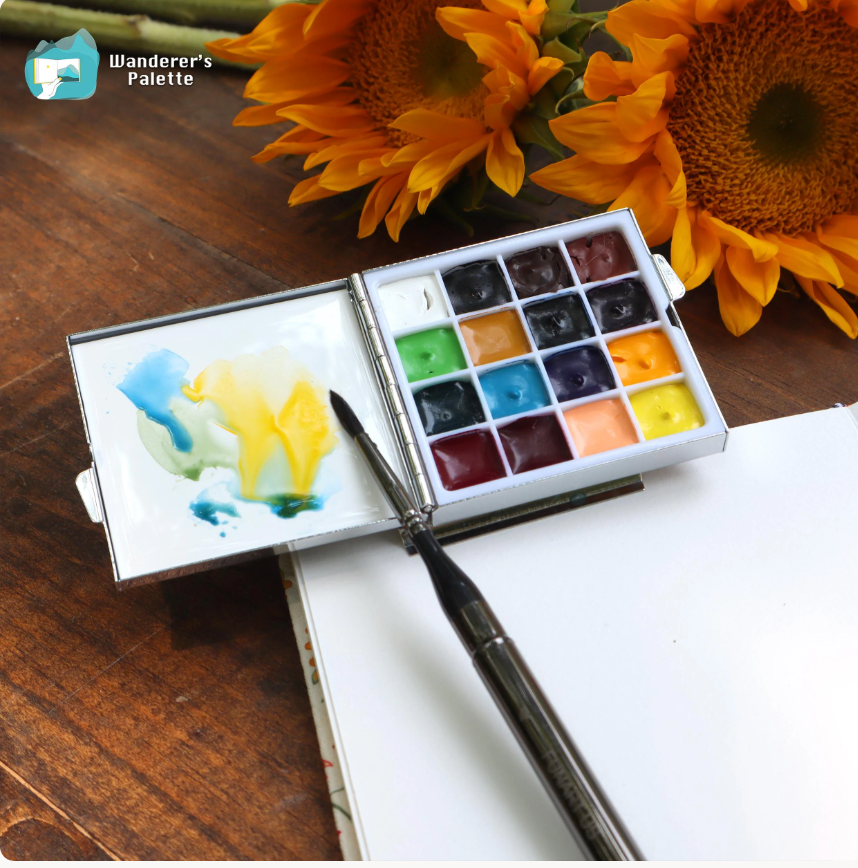
A finished Wanderer's Palette travel watercolor set, ready for painting on the go.
Carrying a dozen watercolor tubes on a trip sounds flexible. Then you find yourself balancing caps, brushes, water, and a sketchbook on a park bench. Decanting tube watercolor into empty watercolor pans turns the colors you already love into a compact, open-and-paint kit. It also gives you control over every color in the box, rather than living with a preselected set.
The process is simple, but the details matter. Tube colors do not all dry the same way. Some shrink into tidy cakes; some crack; some remain tacky; and some need more time or water to wake up. The best method is not to "fix" every color with additives. It is to fill carefully, let each layer cure, and test one pan before committing an entire tube.
The short answer: Yes, most artist-grade tube watercolors can be dried in pans and used successfully for travel. Drying usually changes convenience and pickup more than the pigment itself. Brand, pigment, climate, and formulation can still make a real difference.
Why pans make travel painting easier
A pan palette earns its place in a travel bag because it removes friction. You open one box, mist the colors, and start. There are no loose caps, no surprise spurts from pressure changes, and no need to squeeze out twelve colors before a ten-minute sketch.
Less bulk: Half pans put many colors into a small, lightweight box.
Faster setup: Your working palette is already arranged and ready to wet.
A personal color system: You choose the pigments you actually use and place them in a memorable order.
Less casual waste: Unused paint stays in the pan for the next session instead of being washed from a mixing surface.
Better control outdoors: A dry palette is easier to carry than a box of wet tubes—especially on an airplane or in hot weather.
If you are comparing tube vs pan watercolor for travel, the trade-off is simple. Fresh tube paint is faster when you need a large, saturated wash. A small travel pan is made for compact work, not for feeding a two-inch wash brush. Many painters use both: pans in the field and fresh tube color in the studio.
Drying the paint does not automatically ruin it—but formulas differ
Watercolor is meant to be reactivated with water. Letting tube paint dry does not suddenly change a lightfast pigment into a fugitive one, nor does it erase the pigment's staining or granulating character. What can change is how quickly the paint releases, how much color loads into the brush, and how easily you can mix a saturated puddle.
There is no universal tube-to-pan rule. Jackson's Art notes that some manufacturers use the same paint for tubes and pans, while others adjust the pan formula with wetting agents or different proportions of humectant. Schmincke is cited as using the same paint and filling factory pans in several drying cycles; Winsor & Newton has said its pan and tube formulas are different. That is why two colors, even from the same brand, may behave differently after drying.
My recommendation: Run a one-pan test before filling your whole palette. Let it dry for a week, pre-wet it, and compare a swatch with fresh paint from the tube. Check color strength, flow, granulation, lifting, and how hard you have to scrub. Your own test is more useful than a universal recipe.
The most reliable method is thin layers, full drying, and no trapped air
Choose a focused palette. For travel, begin with the colors you reach for repeatedly. Eight to twelve well-chosen pigments are often more useful than twenty colors you barely know.
Label before filling. Write the brand, color name, and pigment code on the bottom or side of each pan with a waterproof pen. Dry cakes can look almost black, so memory is not enough.
Start with clean, completely dry pans. When decanting tube watercolor, wash any reused pans, remove old residue, and let them dry. Trapped moisture and contamination are avoidable risks.
Massage the tube before opening. Older tubes can separate, sending clear gum arabic out before pigment. Gently knead the closed tube, hold it upright, and open it over the pan.
Fill the first layer only one-third to one-half deep. Push paint into every corner. Stir with a clean toothpick or pin, then tap the pan on the table to release bubbles. Edge-to-edge contact helps the cake stay attached as it shrinks.
Dry uncovered and level. Give the first layer at least 24–48 hours. Thick, honey-rich colors and humid weather can slow the process. A firm skin is not proof that the center is dry. Do not use an oven or hair dryer.
Add the next layer only after the first is solid. Repeat once or twice. Layering reduces deep cracks and avoids trapping a wet center beneath a dry crust.
Leave a shallow lip at the top. A slightly underfilled pan gives you room to add water and swirl a brush without flooding neighboring colors or gluing paint to the lid.
Cure, swatch, and shake-test. Once fully dry, make a labeled swatch. Close the palette and gently test it over a table before taking it outside.
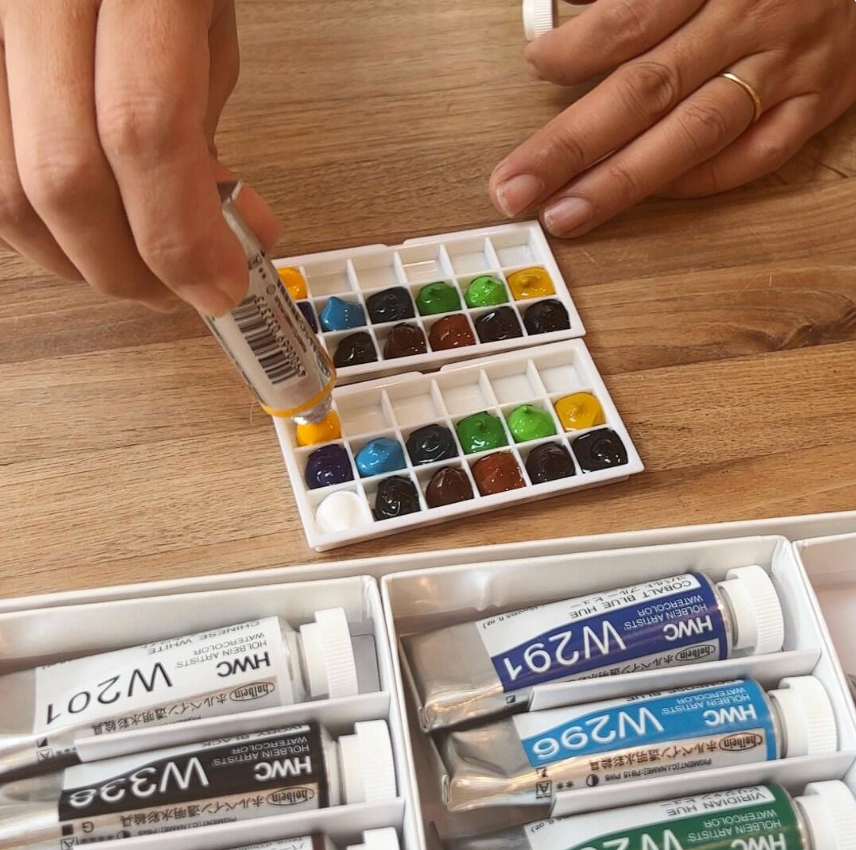
Filling clean palette wells directly from Holbein watercolor tubes.
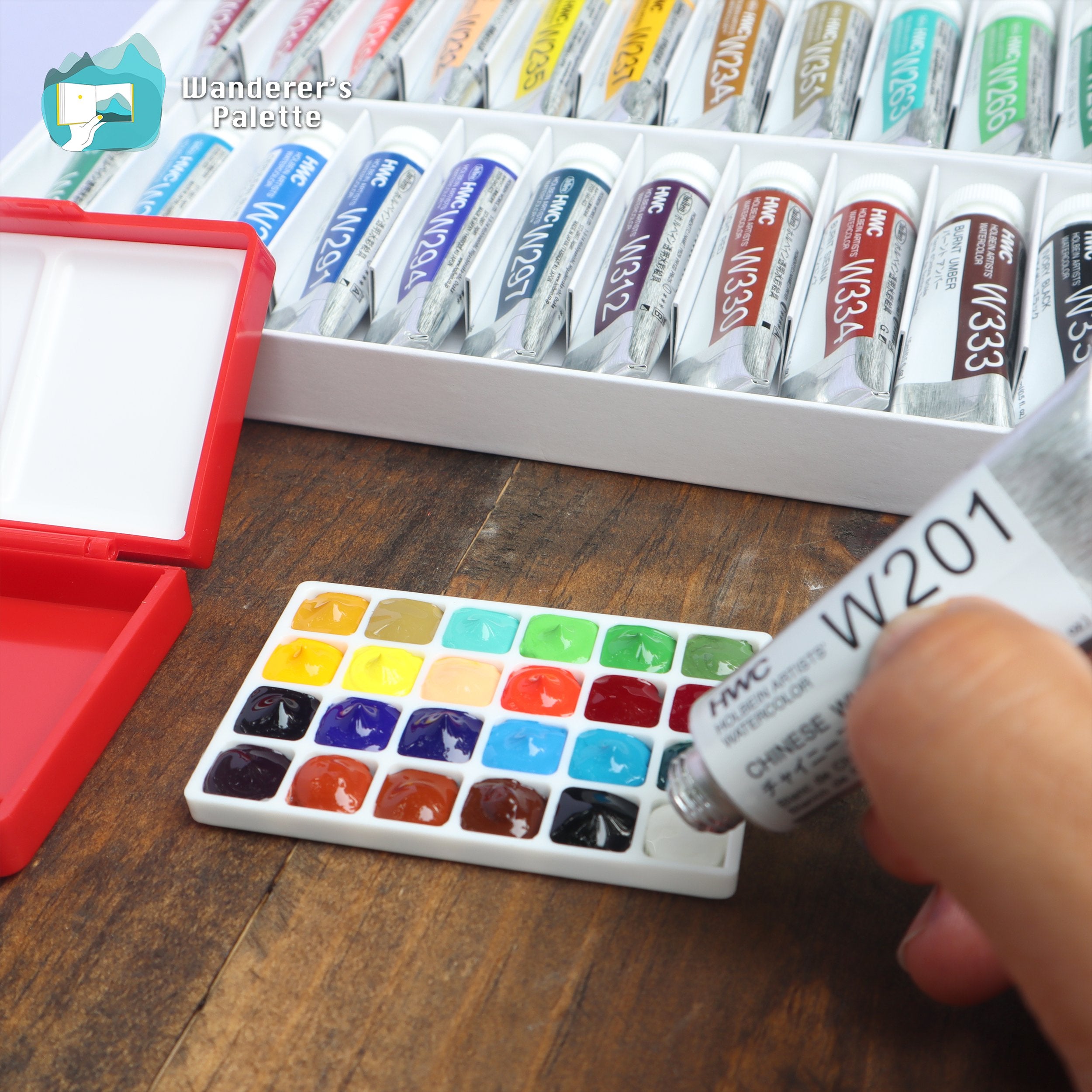
Freshly squeezed paint is the easy part; the real test is how it performs after aging.
🎥 Watch: filling watercolor pans from Holbein tubes — Instagram Reel
Most pan problems are easy to diagnose
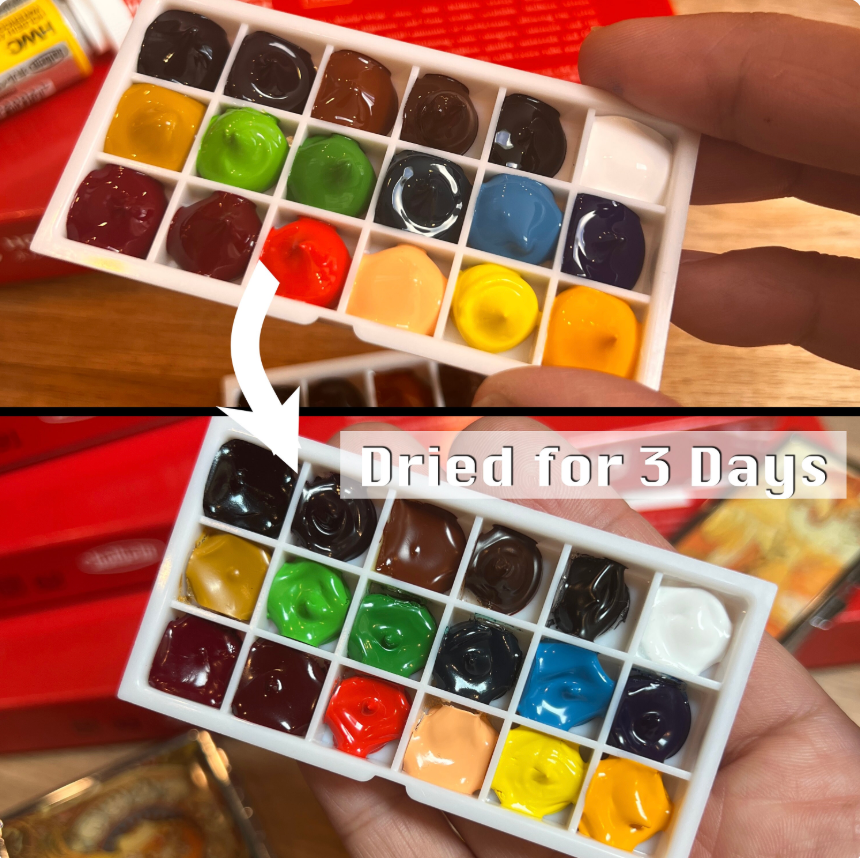
Freshly filled pans and the same palette after three days of drying, showing normal shrinkage as water evaporates.
| What you see | Likely cause | What to do |
|---|---|---|
| Fine surface cracks | Normal shrinkage; pigment-specific drying | Leave it if the cake is secure; fill the gaps during the next layer. |
| Cake lifts out | Poor adhesion, trapped air, or one thick pour | Seat it with a small dab of fresh matching paint underneath; dry fully. |
| Paint stays sticky | Honey-rich formula, thick fill, or humidity | Give it more open-air time; keep the layer thinner; avoid adding more humectant. |
| Paint is rock-hard | Low-humectant formula or hard pigment | Pre-wet longer; test a tiny amount of glycerin in one future pan. |
| Weak color pickup | Too much water or too little soaking time | Add a few drops, wait 3–5 minutes, then lift a creamy mixture gently. |
| Musty smell or mold | Paint was closed while damp or contaminated | Discard affected paint; clean the palette thoroughly; refill in dry layers. |
A cracked cake is not automatically bad paint. If it rewets well and stays in the pan, it can keep working for years. The functional problem is movement: a loose block can fall onto a mixing area or disappear outdoors. The safest "glue" is usually a small dab of the same fresh paint beneath the cake, pressed down and allowed to dry.
Do not add medium unless a test pan proves you need it
Commercial tube watercolor already contains a balanced binder system. Adding extra ingredients changes that balance, so the default answer is: fill one pan without additives first.
Glycerin: useful in tiny amounts for brittle or stubborn paint
Glycerin is both a humectant and a plasticizer: it helps retain moisture and keeps gum arabic from becoming too brittle. A very small amount can improve cracking and rewetting. Too much can leave the paint soft, gummy, slow to dry, or prone to moving in a travel box. Introduce only the smallest practical amount with a toothpick or micro-dropper, mix thoroughly, and test one pan.
Honey: excellent rewetting, but not always travel-friendly
Honey also retains moisture and improves flexibility. It is a legitimate ingredient in many watercolor formulas, but it can stay tacky, especially in humid weather. That can be helpful if you love soft color. It is less helpful when a palette rides vertically in a warm backpack. Honey-rich paint also needs extra care before you close the lid. For a dry, portable set, do not add honey automatically.
Gum arabic: binder, not a universal anti-cracking fix
Gum arabic is the main binder that holds pigment together and lets watercolor redissolve. It is useful when making paint from dry pigment or repairing a truly under-bound, powdery mixture. It is not the first thing to add to commercial tube paint. Kremer Pigmente notes that too much gum arabic can itself create a brittle, cracking paint film. Extra gum can also increase gloss and reduce flow.
A simple rule: If the pan dries hard but rewets with a short soak, add nothing. If it cracks but stays put, add nothing. Modify the formula only when the problem affects painting—and test one color at a time.
Reactivate dried pans by soaking, not scrubbing
Mist or add two to three clean drops. Wet the surface before you set out your paper and brushes.
Wait three to five minutes. Very hard colors may need longer. The goal is a softened top layer, not a flooded pan.
Use the side of the brush. Gently roll or sweep the belly of the brush across the paint. Digging with the tip wears fine brushes and can gouge the softened cake.
Make the puddle on a mixing surface. Lift concentrated color first, then add water deliberately. Pale washes often come from over-dilution, not weak pigment.
If a color still produces a weak, grainy wash after a generous pre-soak, compare it with a fresh-tube swatch. That pigment or brand may simply be better kept as fresh paint. A travel palette does not have to force every tube into the same system.
A dried-up tube can still become a pan
Do not throw away a tube merely because the paint no longer squeezes out. Jackson's Art recommends carefully cutting open the soft metal tube and using the dry color like a pan. Work on a protected surface, cut away from your hand, keep the original label, and transfer manageable pieces into a labeled container.
Avoid pouring a large amount of water back into an old tube and sealing it. You will struggle to mix the binder evenly, and the added moisture can create a storage problem. It is usually simpler to expose the dried paint, place it in a pan, and rewet only what you need.
What experienced painters have learned in practice
Case 1: Three thin pours survived years of field use
Artist and educator Roz Stendahl describes a method developed through more than 20 years of travel-palette use: fill one-third, dry for two or more days, and repeat twice. Her reason is practical, not cosmetic. A full one-shot pour can crust on top while remaining wet underneath; the layered method improves edge-to-edge adhesion and reduces trapped moisture. She also recommends testing rewetting after a week, because brand behavior varies.
Case 2: The brim-full pan became a sticky lid
The artist behind Watercolor Affair recalls filling pans to the brim on a first attempt. Days later, the paint was still soft and stuck to the palette lid. The lesson was to fill only partway, dry naturally for at least 24–48 hours, top up later, and leave headroom for rewetting water. It is exactly the kind of failure a thin-layer method prevents.
Case 3: Brand choice can matter more than the technique
Jackson's Art reports that some tube colors dry hard and take more effort to reactivate, while others rewet readily. Its comparison also notes that a 15 ml tube of Schmincke Horadam can make roughly eight to ten half pans, and that Schmincke fills its own pans in repeated drying cycles. In a WetCanvas discussion, several painters said their dried tube colors worked well after a pre-spritz, while a quoted Winsor & Newton technical response cautioned that its tube and pan formulas differ. Taken together, these accounts support one conclusion: test your actual paint instead of trusting a blanket rule.
Field-tested tips worth keeping
Build a mixing palette, not a color collection. Choose pigments that create useful secondaries and neutrals together.
Photograph the labels. Keep a phone photo of every tube and its pigment code before packing the tubes away.
Make a permanent swatch map. Paint each color in its exact palette position and note brand, color, and pigment.
Keep the warm yellows away from dark staining colors. Color-family organization makes contamination easier to manage.
Leave room for the brush. A half-empty full pan may be more useful than a brim-full half pan.
Dry before closing. After painting, leave the palette open until the paint and mixing surfaces are dry.
Carry the palette flat if any color remains soft. Honey-rich or recently filled pans can creep in heat.
Test before travel. Do a gentle shake test over a table, then paint one small sketch with the exact kit you plan to carry.
Frequently asked questions
Can I put any tube watercolor into a pan?
Usually, yes—but test one pan first. Brand and pigment formulas differ, and some tube colors dry harder or stay softer than others.
Does dried tube watercolor lose quality?
Not automatically. The pigment properties remain, but rewetting speed and the amount of color you can lift may change. Fresh tube paint is still easier for very saturated washes.
How long should a filled pan dry?
Allow at least 24–48 hours per thin layer and longer in humid weather or with honey-rich paint. A dry-looking crust can hide a wet center.
Should I add glycerin to every pan?
No. Add nothing unless a test pan has a real cracking or rewetting problem. If needed, use the smallest practical amount and test before scaling up.
Why did my paint shrink so much?
Tube paint contains water that evaporates. Significant shrinkage is normal; top up with another thin layer after the first is fully dry.
What if the watercolor cake falls out?
Use a small dab of the same fresh paint beneath the cake, press it back into place, and let it dry completely. For a loose plastic pan inside a metal box, use the box's clip, magnet, or a removable adhesive.
Can I close the palette while the paint is still damp?
Avoid it. Moisture trapped in a closed box can make colors stick to the lid and may encourage contamination or mold.
Can I use the same method for gouache?
Traditional rewettable gouache may work, but results vary more and cracking is common. Acrylic gouache is not rewettable after it cures.
Related products
Magnetic Watercolor Travel Palette – 16/18 Holbein Colors — If you'd rather skip the filling and drying, this palette is hand-filled with Holbein colors one well at a time, following the same careful process described in this guide. It arrives ready to open, mist, and paint.
Portable Mini Watercolor Palette – 12 Holbein Colors — For an even smaller kit, this 12-color version is also hand-filled with Holbein watercolor and is a natural fit for minimalist travel.
Mini Handmade Watercolor Palette with Water Bucket — A handmade mini palette with its own water bucket, made for sketching on the go when you want a quick place to rinse your brush wherever you stop to paint.
Make the palette small enough to take and good enough to trust
A travel palette succeeds when it disappears into your routine: a few drops of water, a familiar row of colors, and no extra decisions between you and the page. Fill slowly, test honestly, and let your own climate and pigments tell you what they need.
Ready to build a lighter painting kit? Explore Wanderer's Palette travel watercolor tools and palettes.
Complete your travel kit


Sources and further reading
Jackson's Art — Is Watercolour Better in Pans or Tubes?
RozWoundUp — Paint Advice: Filling Watercolor Pans with Tube Paint
Watercolor Affair — How to Make Watercolor Pans
Jackson's Art — Making Handmade Watercolours with Dry Pigment
Kremer Pigmente — Watercolor Based on Gum Arabic
WetCanvas — Refilling Pans with Tube Paint (community discussion)
Editorial note: Product formulas can change. When a manufacturer publishes current instructions for a specific paint line, follow those instructions over general advice.